
Planting
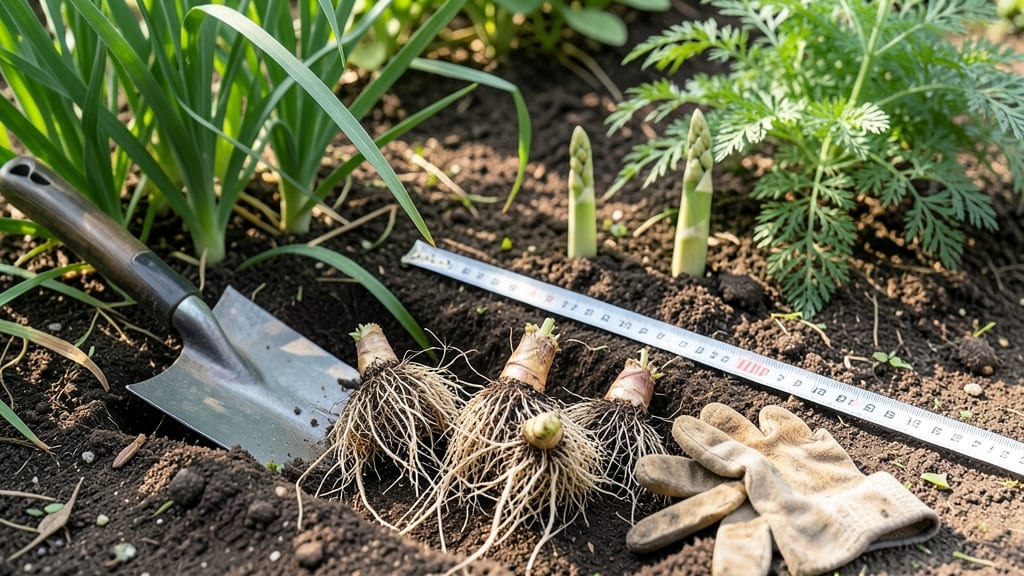
Planting asparagus too close stunts growth, while spacing them too far wastes garden space—but getting it right guarantees thick, healthy spears for years.
If you’ve ever dug up a patch of asparagus 🌱 only to find tangled roots and skinny spears, you’ve already seen what happens when spacing goes wrong. The good news?
This perennial veggie thrives when planted just 12–18 inches apart, with rows 3 feet apart for airflow and easy harvests. Too tight, and you’ll fight for every spear; too wide, and your bed feels like a desert.
Why does spacing matter so much? Asparagus crowns spread over time, and crowded plants compete for nutrients, leading to stunted growth and disease. But get it right, and you’ll enjoy heavy harvests for 15+ years—that’s the magic of proper planting.
Here’s how to nail the distance, adjust for your soil, and avoid the most common mistakes.
In this guide, I’ll walk you through the exact spacing for 1-year vs. 2-year crowns, how to tweak for clay or sandy soil, and what to watch for if your asparagus starts looking stressed.
By the end, you’ll know exactly how close—or far—to plant for a lush, productive bed that keeps giving year after year.
Optimal asparagus planting spacing by crown type and soil conditions
Getting the asparagus spacing right is the difference between a thriving perennial crop and years of disappointment. Asparagus crowns—whether 1-year or 2-year-old—need precise placement to develop strong roots and produce thick, healthy spears for decades.
The wrong spacing leads to crowded roots, disease pressure, and stunted growth, while too much space wastes your garden real estate.
I’ve planted asparagus for over 10 years, and the biggest mistake I see is treating it like a quick-harvest crop. Asparagus is a long-term investment—proper spacing ensures your plants live 15+ years while delivering consistent harvests.
Let’s break down the exact distances for row spacing, in-row spacing, and how to adjust for clay soil vs. loose, sandy soil to maximize your yield.
Here’s the key rule: Asparagus crowns need room to spread. Their roots grow aggressively in all directions, and when they’re crowded, they compete for nutrients and water, leading to thinner spears and yellowing fronds.
But spacing them too far apart means fewer plants per bed, reducing your total harvest. The solution? Follow these science-backed guidelines based on crown type and soil conditions.
For 1-year crowns, I recommend starting with 18–24 inches between rows and 12–15 inches between plants. These young crowns are still establishing their root systems, so giving them a little extra room helps them develop stronger spears in their second year.
If you’re planting 2-year crowns, which already have a head start, you can space rows 24–30 inches apart and plants 15–18 inches apart. The extra space accounts for their larger root systems and ensures they don’t compete for nutrients.
Now, here’s where soil type makes a huge difference. In clay soil, which drains poorly and compacts easily, roots struggle to spread. To compensate, I increase row spacing by 50% and in-row spacing by 30%.
For example, a 1-year crown in clay soil should have 24-inch rows and 18-inch in-row spacing. This gives roots room to expand horizontally where they can’t grow deep.
On the flip side, loose, sandy soil drains too quickly and can’t hold moisture well, so you can tighten spacing by 20–30%. A 1-year crown here might only need 15-inch rows and 10-inch in-row spacing.
One mistake I see is ignoring the depth of planting. Asparagus crowns should sit 3–4 inches below soil level—this protects them from freezing in winter and encourages root growth.
If you plant them too shallow, the crowns can heave out of the soil in cold weather, damaging the roots. After planting, water deeply to settle the soil around the crowns and eliminate air pockets.
Mulch with 2–3 inches of straw or wood chips to retain moisture and regulate soil temperature.
Let’s talk about raised beds, which are a game-changer for asparagus. In raised beds, I reduce in-row spacing by 20% because the roots can’t spread as widely as in open ground.
For example, 1-year crowns in a raised bed might be spaced 10–12 inches apart in rows that are 18 inches apart. The key is to keep the bed width manageable—no wider than 4 feet—so you can reach the center without compacting the soil.
Raised beds also warm up faster in spring, giving asparagus a head start on growth.
If you’re planting asparagus in containers or pots, spacing changes dramatically. Each plant needs at least a 12-inch diameter pot, and you can fit 1–2 crowns per container, depending on size. The critical factor here is drainage—asparagus roots rot in soggy soil. Use a <
Common mistakes in asparagus spacing and how to fix them
Even with the right planting spacing, asparagus can still struggle if your soil is compacted or roots are competing for nutrients. One of the biggest red flags? Yellowing fronds that appear weak and sparse, even after years of growth.
This often means your plants are overcrowded or fighting for space with neighboring roots. Another telltale sign is stunted spears—thin, woody, or slow to emerge in spring.
Root competition is another sneaky issue, especially in clay-heavy soil where drainage suffers. When roots can’t spread freely, they become tangled, leading to poor nutrient uptake and increased disease risk.
Even if you spaced plants correctly at planting, soil compaction from foot traffic or heavy mulch can squeeze roots together over time. The result? Fewer spears and more frustration at harvest time.
⚠️ Warning: How Close to Plant Asparagus?
Planting asparagus too close (under 12 inches) leads to root competition, while spacing over 18 inches wastes space and reduces yields. The ideal 12–18 inches apart allows roots to spread without smothering neighbors. For clay soil, widen to 18–24 inches to prevent compaction.
If you notice yellowing fronds or stunted spears, the first step is to assess your row spacing. Asparagus needs 3 feet between rows for proper airflow and easy access during harvest. If rows are too tight, prune back the ferns in late fall to reduce competition.
For established beds, thin out the crowded crowns by carefully digging up and transplanting the most vigorous plants to a new location.
Soil compaction is another common issue, especially in gardens with heavy foot traffic. To fix it, aerate the soil with a garden fork in early spring, loosening the top 6–8 inches around each plant. Mix in compost or aged manure to improve drainage and nutrient availability.
Avoid walking on the bed, and consider adding a 2–3 inch layer of mulch to protect the soil structure while keeping roots cool.
For newly planted asparagus, monitor growth closely in the first year. If fronds appear weak or sparse, it may signal inadequate spacing. Dig gently around the base to check root spread—if roots are tangled, thin immediately.
In sandy soil, increase spacing to 18 inches to prevent roots from drying out too quickly. The goal is to give each plant enough room to develop a strong crown without competing with neighbors.
One final tip: If your asparagus bed is overcrowded, don’t panic. With proper pruning, soil amendments, and careful thinning, you can revive even the most neglected patch. Focus on airflow and root health, and your spears will bounce back stronger than ever.
A well-spaced asparagus bed isn’t just about aesthetics—it’s the key to bountiful harvests for decades.