
Planting
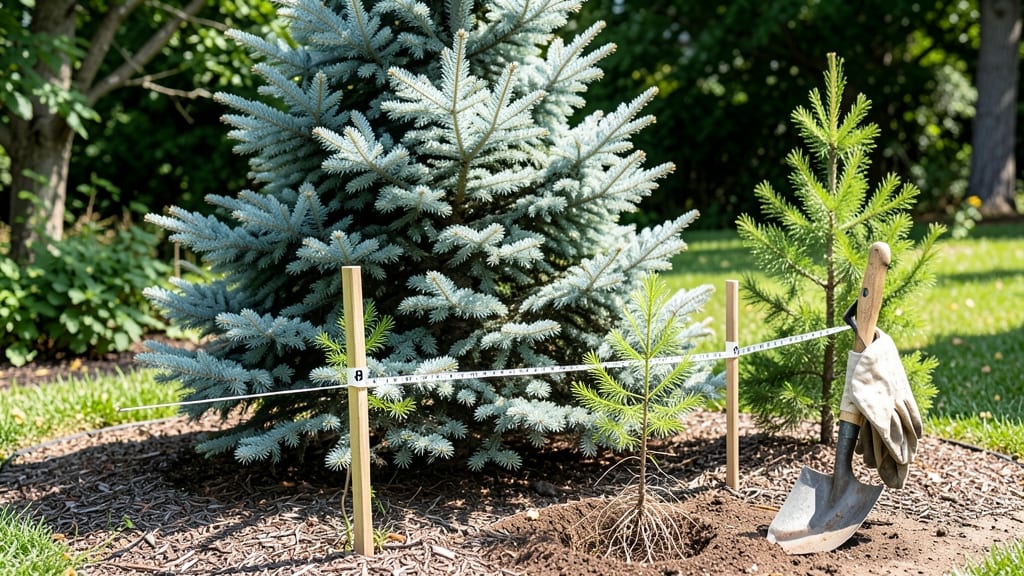
Planting Colorado Blue Spruce 🌲 too far apart wastes space, while crowding them stunts their majestic growth and leaves you with scraggly, weak trees.
Picture this: a perfectly manicured hedge that looks like a postcard in autumn, or a single specimen tree standing tall as a natural focal point. The difference between these two outcomes often comes down to one critical factor—spacing.
Too little space, and you’ll spend years pruning and battling disease. Too much, and your landscape feels sparse and unbalanced.
For most Colorado Blue Spruce varieties, the ideal spacing is 8 to 12 feet apart for hedges and 15 to 20 feet apart for specimen plantings.
This accounts for their mature width of 10 to 20 feet and ensures they have room to develop strong root systems and full, vibrant foliage without competing for nutrients or sunlight.
In this guide, I’ll break down the exact spacing you need based on your planting goals—whether you’re creating a formal hedge or a natural woodland edge—plus how to adjust for windy climates, compact cultivars, and soil conditions that can make all the difference in long-term success.
Optimal Colorado Blue Spruce spacing by planting purpose (hedge vs. specimen)
Colorado Blue Spruce (Picea pungens) is a stunning evergreen that thrives with proper spacing—whether you're creating a formal hedge or showcasing it as a specimen tree. The key difference lies in their mature width and how they'll interact with neighboring plants.
Standard varieties can reach 3-4 feet wide at maturity, while larger specimens may spread up to 6 feet or more.
For hedge plantings, tight spacing creates a dense, uniform barrier, but too close can lead to fungal diseases and stunted growth. Meanwhile, specimen plantings need room to develop their iconic blue-green foliage without competition.
Let's break down the exact distances for each scenario, including sunlight exposure and soil drainage considerations.
🌲 Pro Tip: Always account for the root flare—planting too deep can suffocate roots. Use a spade to mark depth before digging.
When planting for a hedge, aim for 3–4 feet apart to ensure the branches fill in naturally without gaps. This spacing allows for pruning flexibility while maintaining a dense, uniform look.
For specimen trees, give them 8–10 feet of clearance to develop their full majestic form and avoid root competition.
In windy climates, increase spacing to 5–6 feet for hedges to prevent windburn and breakage. The blue foliage of Colorado Blue Spruce is stunning, but it’s delicate—proper airflow reduces stress.
If you're planting near a property line, check local regulations, as some areas require setback distances of 5–10 feet.
For soil preparation, amend heavy clay with compost or sand to improve drainage. Colorado Blue Spruce hates soggy roots, which can lead to root rot. If your soil is poorly draining, consider planting on a slight mound to elevate the root zone.
Mulch with pine straw or wood chips to retain moisture and suppress weeds.
After planting, water deeply once a week for the first year to establish roots. Avoid overwatering, as these trees are drought-tolerant once established. In USDA Zones 3–8, they thrive with minimal care, but young trees benefit from seasonal fertilizer (10-10-10) applied in spring and fall.
If you're mixing Colorado Blue Spruce with other evergreens like Arborvitae or Juniper, space them 5–6 feet apart to avoid shading conflicts. Their needle-like foliage creates beautiful texture contrasts, but they compete for sunlight.
For a layered landscape, plant taller trees (like Ponderosa Pine) behind and shorter ones (like Dwarf Alberta Spruce) in front.
🌲 Long-Term Tip: Prune hedges in late winter or early spring before new growth begins. Use sharp, clean shears to make angled cuts just above a bud. For specimen trees, avoid heavy pruning—focus on removing dead branches and shaping only when necessary.
Common mistakes that ruin Colorado Blue Spruce spacing (and how to fix them)
Even experienced gardeners sometimes make spacing mistakes with Colorado Blue Spruce that sabotage their growth. The most common error? Planting them too close together—which creates competition for water, nutrients, and sunlight.
Over time, this leads to stunted growth, poor needle density, and even disease susceptibility. I’ve seen entire hedges fail because of this simple oversight.
Another frequent mistake is ignoring the root flare when planting. Many gardeners bury the roots too deep, which suffocates the tree and prevents proper root development. This is especially critical for Colorado Blue Spruce, which needs strong roots to support its towering height.
Even a few inches too deep can weaken the tree’s stability over time.
⚠️ callout warning
⚠️ Spacing Mistakes That Kill Your Spruce
- Planting too close: 6-8 feet apart for standard varieties, 10+ feet for full maturity. Crowding causes needle loss and weak branches.
- Ignoring root flare: Plant with the root flare visible above soil—burying it 2+ inches deep strangles growth.
- Poor soil prep: Amend clay soil with compost or sand; Colorado Blue Spruce hates soggy roots.
- Skipping mulch: Apply 3-inch mulch ring (keep mulch 6 inches from trunk) to retain moisture and regulate soil temp.
Pro Tip: Use a spading fork to loosen soil 18 inches deep before planting—this prevents root restriction.
Poor soil preparation is another silent killer. Many gardeners assume Colorado Blue Spruce thrives in any soil, but these trees actually prefer well-draining, slightly acidic soil (pH 6.0–7.0). If your soil is heavy clay or compacted, roots struggle to expand, leading to shallow root systems and top-heavy trees.
I’ve seen spruces topple in windstorms because their roots couldn’t anchor properly.
Don’t overlook the importance of mulching either. A thick layer of mulch helps regulate soil temperature and retain moisture, but many gardeners either skip mulching entirely or pile it too close to the trunk.
The correct method is to create a 3-inch mulch ring that starts 6 inches away from the trunk. This protects the roots while preventing rot.
If you’ve already planted your Colorado Blue Spruce too close, don’t panic—there are ways to fix it. For young trees, carefully prune competing branches to reduce canopy size while you wait for them to outgrow the crowding.
For mature trees, consider gradual thinning by removing one tree every few years until you reach the ideal spacing of 10–15 feet apart.
Finally, always consider your local climate. In windy regions like Colorado’s Front Range, spacing trees 15–20 feet apart gives them room to sway without breaking. In sheltered yards, you can get away with slightly closer spacing, but never less than 8 feet for standard varieties.
Proper spacing now saves you years of frustration later.