
Planting
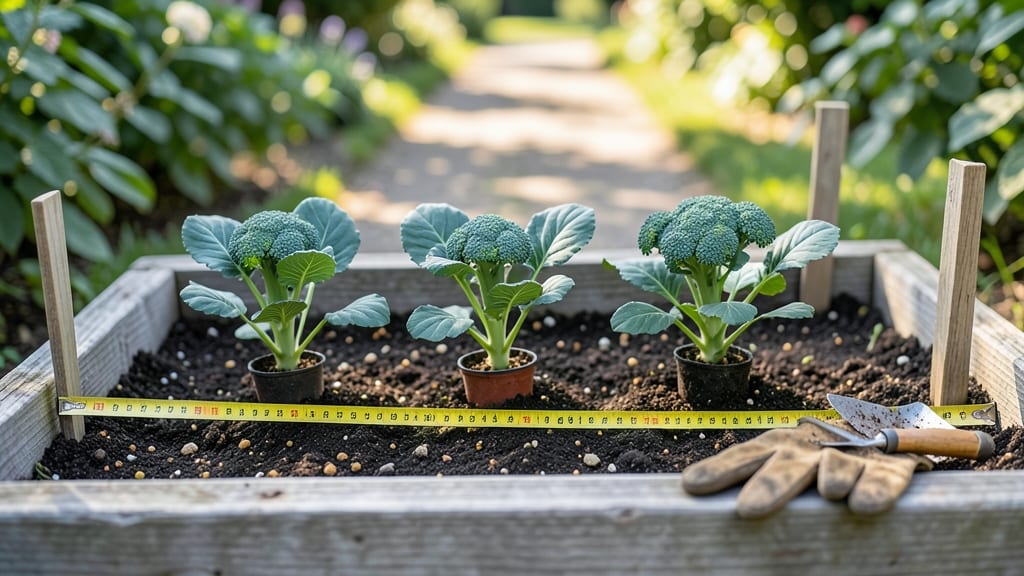
To plant broccoli in a raised bed, space them 12 to 18 inches apart within rows and leave 24 to 36 inches between rows for optimal air circulation and head growth. Compact varieties can handle closer spacing, while larger plants need extra room to develop fully.
Proper spacing prevents overcrowding, which can lead to smaller heads and increased disease risk. 🌱 In a raised bed, this spacing also helps maximize sunlight exposure and soil nutrient distribution.
I’ve found that adjusting for your specific broccoli variety—like the bushier Calabrese or the more compact Romanesco—can make a noticeable difference in yield and plant health.
For high-density planting, consider using smaller varieties or trellising techniques to save space while still meeting the plant’s airflow needs. This approach is especially useful if you’re growing multiple crops in the same bed or practicing succession planting for continuous harvests.
💡 In This Article
- Broccoli Spacing Science: Why Proper Distance Boosts Yield
- Raised Bed Broccoli Layout: Maximizing Space and Productivity
Broccoli spacing science: why proper distance boosts yield
Broccoli plants compete for three critical resources: sunlight, water, and nutrients. When you space them 12 to 18 inches apart in rows, you create an optimal balance—roots don't tangle, leaves don't shade each other, and air circulates freely.
This spacing prevents a phenomenon called "root competition," where plants grow shallow roots to access surface nutrients, weakening their structure and reducing head size. 🌱 In a raised bed, this competition is even more pronounced because the soil volume is limited compared to in-ground planting.
The 24 to 36 inches between rows rule addresses another key factor: sunlight exposure. Broccoli is a "sun-loving" crop that needs 6 to 8 hours of direct sunlight daily for proper head formation.
Closer row spacing forces plants to lean or stretch toward light, creating "etiolated" stems that are weak and prone to lodging (falling over).
Varieties like Calabrese develop heads weighing 1 to 2 pounds when properly spaced, while overcrowded plants may produce heads no larger than 6 to 8 ounces—a 75% reduction in yield.
Disease prevention is another critical reason for spacing. Broccoli is susceptible to fungal infections like downy mildew, which thrive in humid, stagnant air created by overcrowding. Proper spacing improves airflow, reducing humidity around leaves by up to 30%.
This is especially important in raised beds where soil dries faster, creating microclimates that can trap moisture. 💧 The extra row spacing also makes it easier to spot early signs of pests like cabbage worms, allowing for targeted intervention before infestations spread.
Different broccoli varieties have distinct spacing needs based on their growth habits. Calabrese, the classic large-headed variety, typically needs the full 18 inches apart spacing to develop its 6 to 8-inch diameter heads. Sprouting broccoli, which produces multiple small heads, can tolerate 12 inches apart since its harvest is staggered.
Romanesco, with its fractal-like heads, often needs 15 inches apart because its unique shape requires more lateral space to develop properly without crowding neighbors.
Soil nutrient allocation plays a hidden but crucial role. Broccoli is a "heavy feeder," meaning it requires consistent access to nitrogen, phosphorus, and potassium. When plants are too close, they deplete nutrients in a small soil volume, leading to nutrient deficiencies that manifest as yellowing leaves or stunted growth.
In raised beds, where soil volume is typically 12 to 24 inches deep, proper spacing ensures each plant has access to a dedicated nutrient zone without competition. 🌿 This is why organic gardeners often recommend side-dressing with compost when plants reach 6 to 8 inches tall—it replenishes nutrients in the root zone created by proper spacing.
What most gardeners don't realize is how spacing affects the plant's internal chemistry. When broccoli plants are crowded, they produce more ethylene gas—a natural plant hormone that triggers flowering.
This premature flowering can cause the plant to bolt (send up a flower stalk) before forming a proper head, especially in warm weather. Proper spacing delays this process, allowing the plant to focus energy on head development rather than reproduction.
This is why your spring-planted broccoli might produce larger heads than summer plantings, even with identical care.
For maximum yield, consider this spacing hierarchy: start with 18 inches apart for large varieties, then adjust downward based on your bed's dimensions and variety.
In a 4-foot wide raised bed, you can fit 2 rows with 18 inches between plants and 24 inches between rows, giving you space for companion plants like lettuce or radishes in the gaps.
The key is thinking of your raised bed as a three-dimensional space where vertical growth (via proper spacing) is just as important as horizontal layout. ✨