
Planting
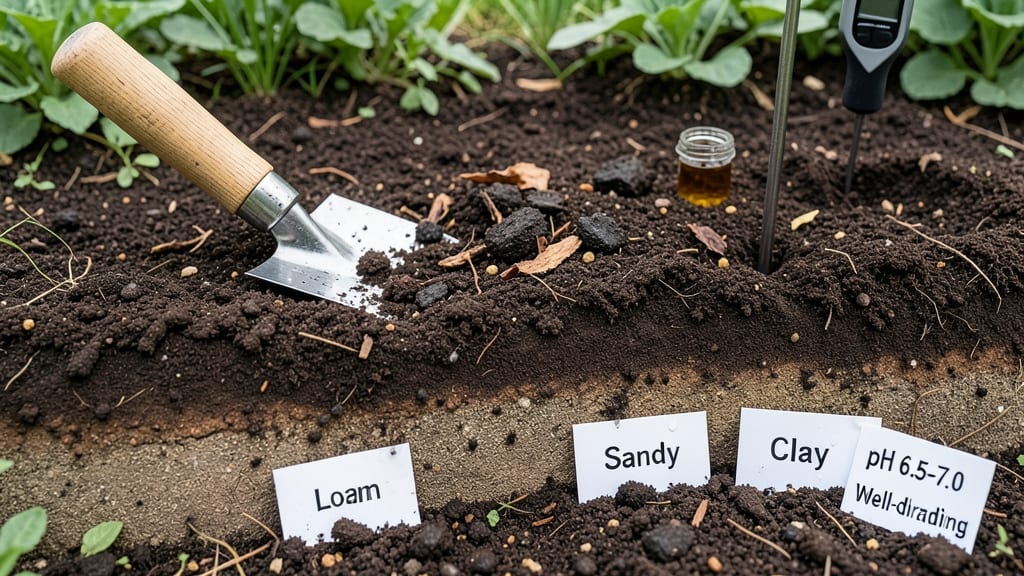
The ideal soil for plant growth balances drainage, aeration, and nutrient retention, typically featuring loamy texture, a pH range of 6.0–7.0, and organic matter like compost or peat. Adjustments depend on the plant type—acid-loving blueberries or alkaline-tolerant lavender require tailored pH levels.
Creating the perfect growing medium starts with understanding how soil particles work together.
A loamy texture—about 40% sand, 40% silt, and 20% clay—gives roots the right balance of airflow and moisture retention. 🌱 The pH range of 6.0–7.0 unlocks essential nutrients: too acidic, and plants starve for phosphorus; too alkaline, and iron becomes unavailable.
For example, I always test my garden soil before planting blueberries, since they thrive in acidic conditions (pH 4.5–5.5), while roses prefer slightly alkaline soil (pH 6.0–7.5). Organic matter like compost or worm castings further boosts microbial activity, breaking down nutrients into forms roots can absorb.
Most gardeners overlook the importance of soil structure until problems arise—like waterlogged roots or stunted growth. That's why I recommend amending your soil with 1–2 inches of compost before planting, especially for heavy clay soils.
For container plants, I mix equal parts potting soil, perlite, and coco coir to improve drainage while keeping moisture. The key is adapting your approach: vegetable gardens need nutrient-rich loam, while succulents require fast-draining mixes with added grit.
💡 In This Article
- How Soil Composition Affects Root Health and Plant Nutrition
- Plant-Specific Soil Mixes: DIY Blends for Vegetables, Flowers, and Trees
How soil composition affects root health and plant nutrition
The magic of ideal soil lies in its particle composition—a delicate balance between sand, silt, and clay that determines how roots breathe, drink, and feed. Sand particles (0.05–2mm) create air pockets for oxygen flow, while silt (0.002–0.05mm) holds moisture like a sponge.
Clay (<0.002mm) acts as a nutrient magnet, but too much can suffocate roots by compacting. A loamy mix (40% sand, 40% silt, 20% clay) gives roots the perfect trifecta: drainage, water retention, and nutrient access.
For example, tomato plants need this balance to develop strong root systems, while shallow-rooted basil thrives in lighter mixes with 30% sand to prevent waterlogging. 🌱
pH levels act like a gatekeeper for nutrients—too high or low, and plants can't access what they need. At pH 6.0–7.0, nitrogen, phosphorus, and potassium become readily available, but shift the pH and nutrients lock up.
Acid-loving plants like blueberries (pH 4.5–5.5) need aluminum and manganese, which dissolve in acidic soil, while alkaline-tolerant lavender (pH 6.5–8.0) thrives when calcium and magnesium dominate.
The science is simple: adjust pH with elemental sulfur (to lower) or lime (to raise), but test first—overcorrecting can harm beneficial microbes. I once killed a batch of azaleas by adding too much lime, thinking it would help their yellowing leaves!
Organic matter isn't just food for plants—it's a microbial powerhouse. Compost and peat moss introduce beneficial bacteria and fungi that break down complex nutrients into plant-available forms. A soil with just 5% organic matter can double microbial activity compared to sterile potting mix.
These microbes also produce glomalin, a sticky protein that binds soil particles into stable aggregates, improving aeration. For deep-rooted trees like oak, this means roots can explore 6–10 feet deep for water, while herbs like thyme with shallow roots (1–2 feet) rely on surface-level organic layers. 💫
Drainage isn't just about water flow—it's about oxygen delivery. Roots respire like tiny lungs, and compacted soil cuts off their air supply. That's why I always add perlite or vermiculite to heavy clay soils: these minerals create air channels while retaining moisture.
For container plants, I mix 1 part potting soil to 1 part perlite to prevent root rot. The trade-off? Too much sand drains too fast, flushing away nutrients. The solution? Use organic amendments like coconut coir, which holds water like a sponge but breaks down slowly, feeding roots over time.
Let's talk about nutrient availability—the real star of soil science. Phosphorus, for example, becomes locked up in alkaline soils, causing stunted growth in plants like beans that need it for root development. Iron, on the other hand, precipitates out in alkaline conditions, leading to yellowing leaves in acid-lovers like hydrangeas.
The fix? For phosphorus, add bone meal; for iron, use chelated iron supplements. I once had a client's roses turning yellow—turns out, their pH 8.0 soil was starving the plants of iron. A simple soil test and a few drops of chelated iron fixed it in weeks! ✨
Don't overlook the role of soil structure in disease prevention. Well-aerated soil discourages fungal pathogens like root rot by keeping roots dry. That's why I recommend raised beds for vegetables—they warm up faster in spring and drain better than in-ground plots.
For trees, deep tilling with organic matter creates a "root zone" that extends 12–18 inches deep, giving roots room to grow without competing with surface weeds. The key takeaway? Soil isn't just dirt—it's a dynamic ecosystem where physics, chemistry, and biology collide to either nourish or strangle your plants. 🌿