
Planting
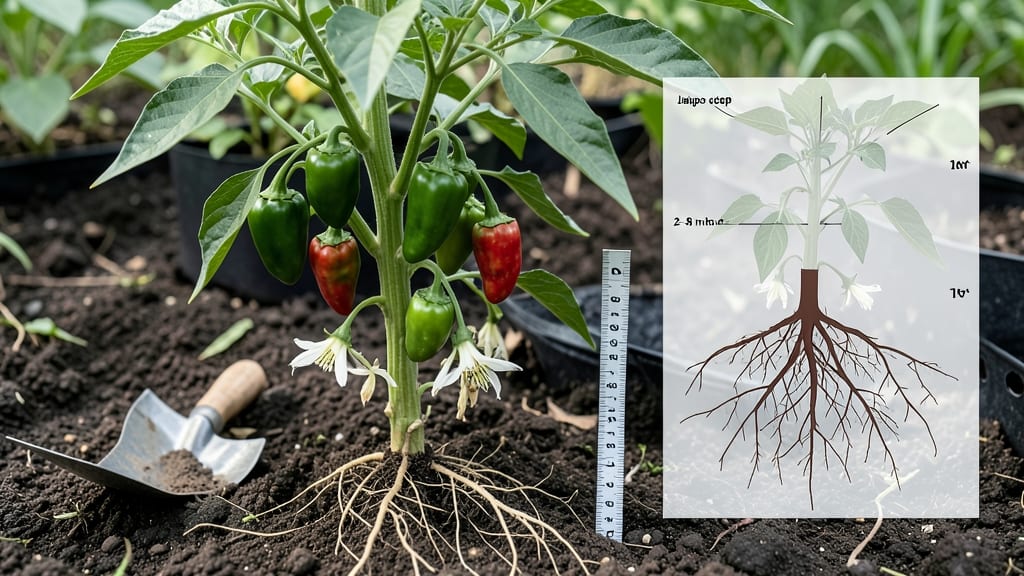
Jalapeño roots grow 12 to 18 inches deep, though some lateral roots spread 18 to 24 inches wide. Well-draining soil with at least 12 inches of depth supports strong growth and prevents root crowding in containers or raised beds.
Understanding how deep jalapeño roots reach helps you plan your garden or container setup for maximum plant health. 🌱 The deep taproot (12-18 inches) anchors the plant while absorbing water and nutrients from lower soil layers, while the wide lateral roots (18-24 inches) spread to capture moisture and minerals from surrounding areas.
This dual system explains why shallow planting—especially in containers under 5 gallons—often leads to poor growth or blossom-end rot in peppers. I’ve found that amending soil with compost improves both root development and fruit production significantly.
For container growers, the 12-inch minimum depth rule applies to the soil layer, not the pot itself—meaning you’ll need at least a 14-inch-deep container to accommodate roots plus drainage space. In ground planting, focus on loosening the top 18 inches of soil to encourage root expansion.
Heavy clay soils? Mix in perlite or coarse sand to prevent waterlogging, which can suffocate roots.
💡 In This Article
- Jalapeño Root System: Depth vs. Spread Explained
- Optimal Soil Depth for Jalapeños: Containers vs. Ground Planting
Jalapeño root system: depth vs. spread explained
Jalapeños develop a biphasic root system—a deep taproot (12-18 inches) paired with fibrous lateral roots that spread horizontally (18-24 inches wide). The taproot anchors the plant while accessing moisture and nutrients from lower soil layers, where organic matter often accumulates.
This vertical reach explains why jalapeños thrive in deep, loose soil—roots can penetrate beyond the top 6 inches where evaporation concentrates salts, reducing stress on the plant. 🌱
The lateral roots act like a nutrient-harvesting network, spreading wider than they grow deep. Studies show these roots concentrate near the soil surface (top 6 inches) but extend their reach to absorb 80% of water from surrounding areas.
This dual system makes jalapeños particularly sensitive to root restriction—when planted too shallow (under 12 inches), the taproot struggles to anchor, leading to weak stems and poor fruit set. In extreme cases, shallow roots can't compensate for drought, causing blossom-end rot.
Soil texture plays a critical role here. Sandy soils drain too quickly, forcing roots to grow deeper in search of moisture, while clay soils suffocate roots by limiting oxygen. The ideal balance is loamy soil with 50% mineral particles, 25% organic matter, and 25% air pockets.
Amending heavy clay with compost or perlite (1 part amendment to 3 parts soil) creates the porous structure roots crave. 🌿
What most gardeners overlook is the root zone's role in heat tolerance. Jalapeños prefer soil temps between 70-85°F—roots in shallow containers heat up faster, stressing the plant. Deep soil acts as a thermal buffer, keeping roots cooler during hot days.
This is why raised beds (12+ inches deep) often outperform in-ground planting in hot climates—they maintain stable root-zone temperatures.
For container growers, the 5-gallon minimum rule exists for a reason: a 12-inch-deep pot with 5 gallons of soil provides just enough volume for the taproot to develop. Smaller pots (like 1-gallon containers) force roots to circle tightly, competing for nutrients and increasing disease risk.
The key is depth over width—a 12-inch-deep, 12-inch-wide pot works better than a shallow 18-inch-wide planter.
Here’s a quick comparison: in-ground jalapeños can develop 20% larger root systems than container-grown plants due to unlimited soil space. However, containers offer control—you can tailor soil mix and drainage to mimic ideal conditions.
The trade-off? Container plants may need weekly deep watering (2-3 inches per week) to compensate for limited root reach. 💧